Overview
Apologies is best played with 4 players and these rules are written with teams in mind. There are variants below for 2 or 3 players, but if you don’t like how it plays with fewer people, change it. House rules exist for a reason.
You play cards to move your pegs in various ways with the goal of getting all yours and your teammate’s pegs into the finishing spaces.
Setup
- Split into two teams. Teammates sit opposite each other around the board.
- Each player places their pegs in their starting section on the board.
- Choose the starting dealer based on whoever has the worst breath (or whatever you feel like /shrug).
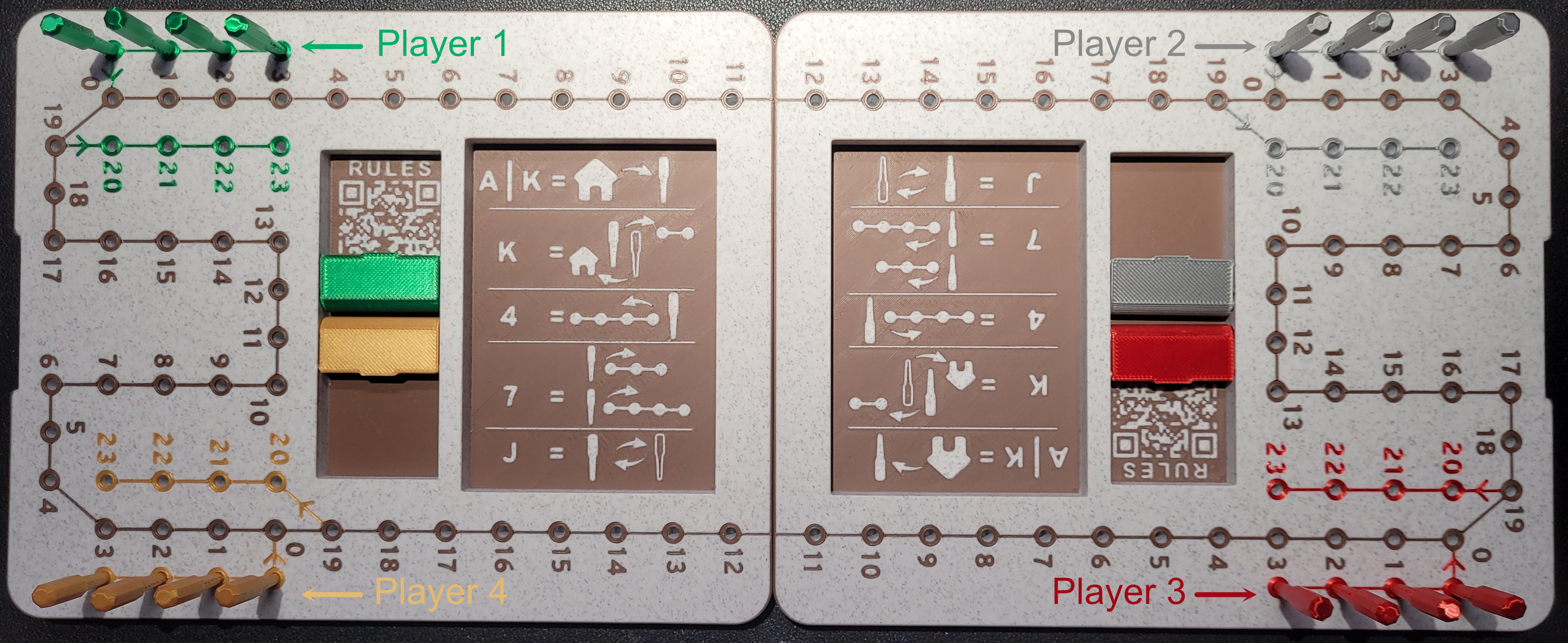
Gameplay
Deal (3 hands per dealer)
Each round begins with the deal. The dealer chooses whether the current hand will be 4 or 5 cards and must deal two 4‑card hands and one 5‑card hand over three rounds.
Card exchange (teammates)
After dealing, teammates exchange one card face down.
Turn order
The player to the dealer’s left begins. Play proceeds clockwise; on your turn, play exactly one card if possible.
Face value vs special ability
Cards may be played for face value or their special ability. You are never required to use the special ability.
No legal play
If you have no legal play, discard your hand face up. When discarding a full hand, you may move one peg forward one space.
Next hand / next dealer
When all cards are played or discarded, the next dealer collects them. After three hands, the next dealer shuffles and becomes the dealer.
Finished players
When a player finishes all their pegs, they discard remaining cards and play their teammate’s pegs in future rounds.
Rules (Priority Order)
Rules should be prioritized in sequence. If there is a conflict, follow the higher‑order rule first—or make house rules. It’s just a game.
- 1Once in your finish, your piece cannot leave.
- 2You cannot pass pieces in your finish.
- 3If you can play, you must (even if you don’t want to).
- 4Simply passing players does nothing unless it is done with a King.
- 5If you can’t play you must discard your hand; face up and fanned out so all players can see which cards are no longer available.
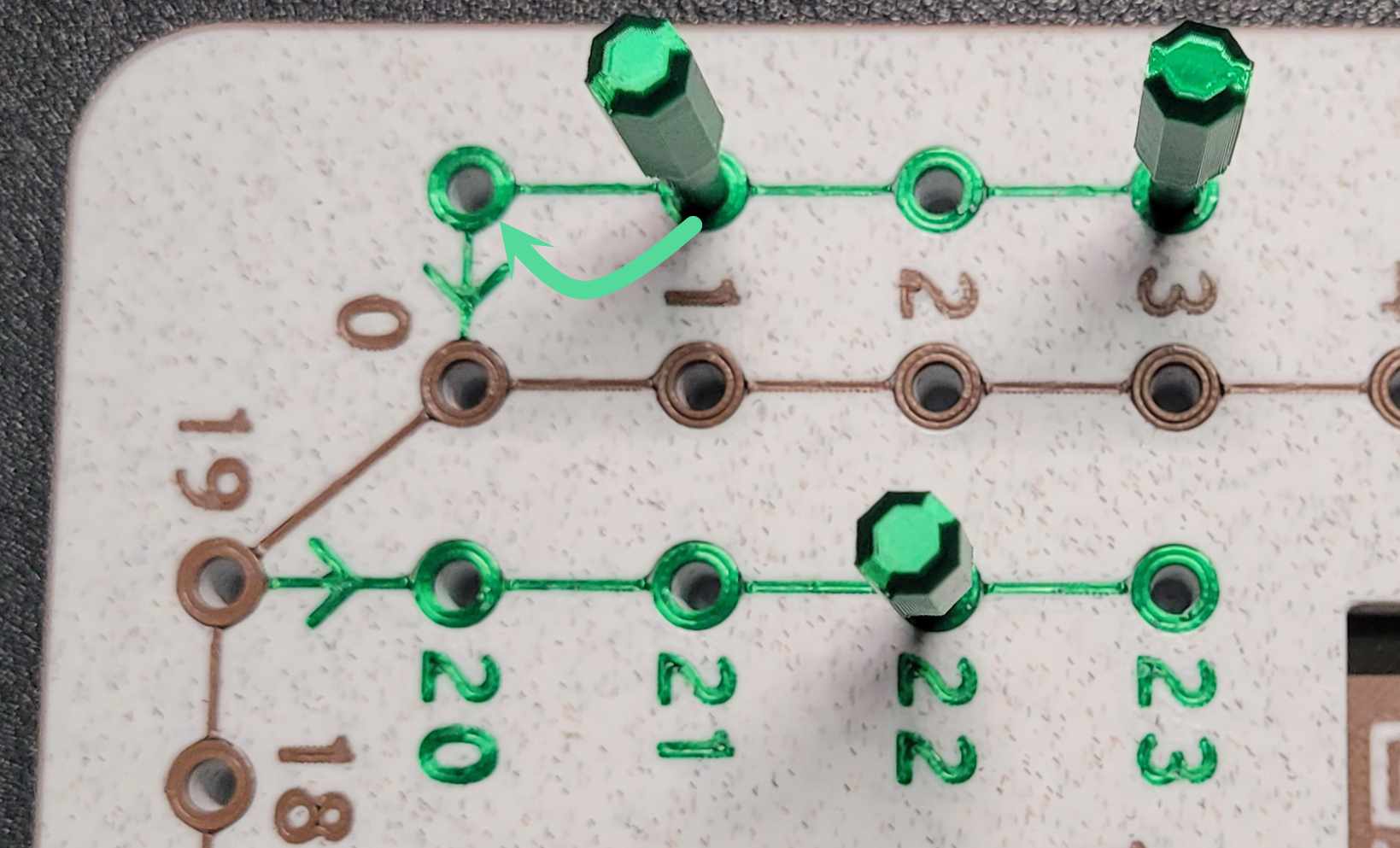
- 6If you discard a full hand then you can move 1 piece forward 1 place (Start 4 → Start 3, for example).
- 7Once you have all of your pieces in your finish then you discard what’s left of your hand.
- 8If you land on another piece that piece is sent home.
- 9You cannot land on your own piece. If your only play lands on your own piece, you’re unable to play and must discard your hand.
- 10You can land on your teammate’s pieces. If you do, they are sent back to their start.
- 11When a piece is sent back to start it goes to the furthest available starting point (if Start 3 is available it goes there and not to Start 1).
- 12Once your pieces are all in your finish spaces you start playing the same pieces as your teammate.
- 13If both yours and your teammate’s pieces are all in their respective finish spaces then you’ve won the game.
Special Cards
All cards can be played as face value instead of their special abilities below (Ace = 1, Jack = 11, King = 13). The symbols on the board are reminders so you don’t need to ask during the game and give away your hand.
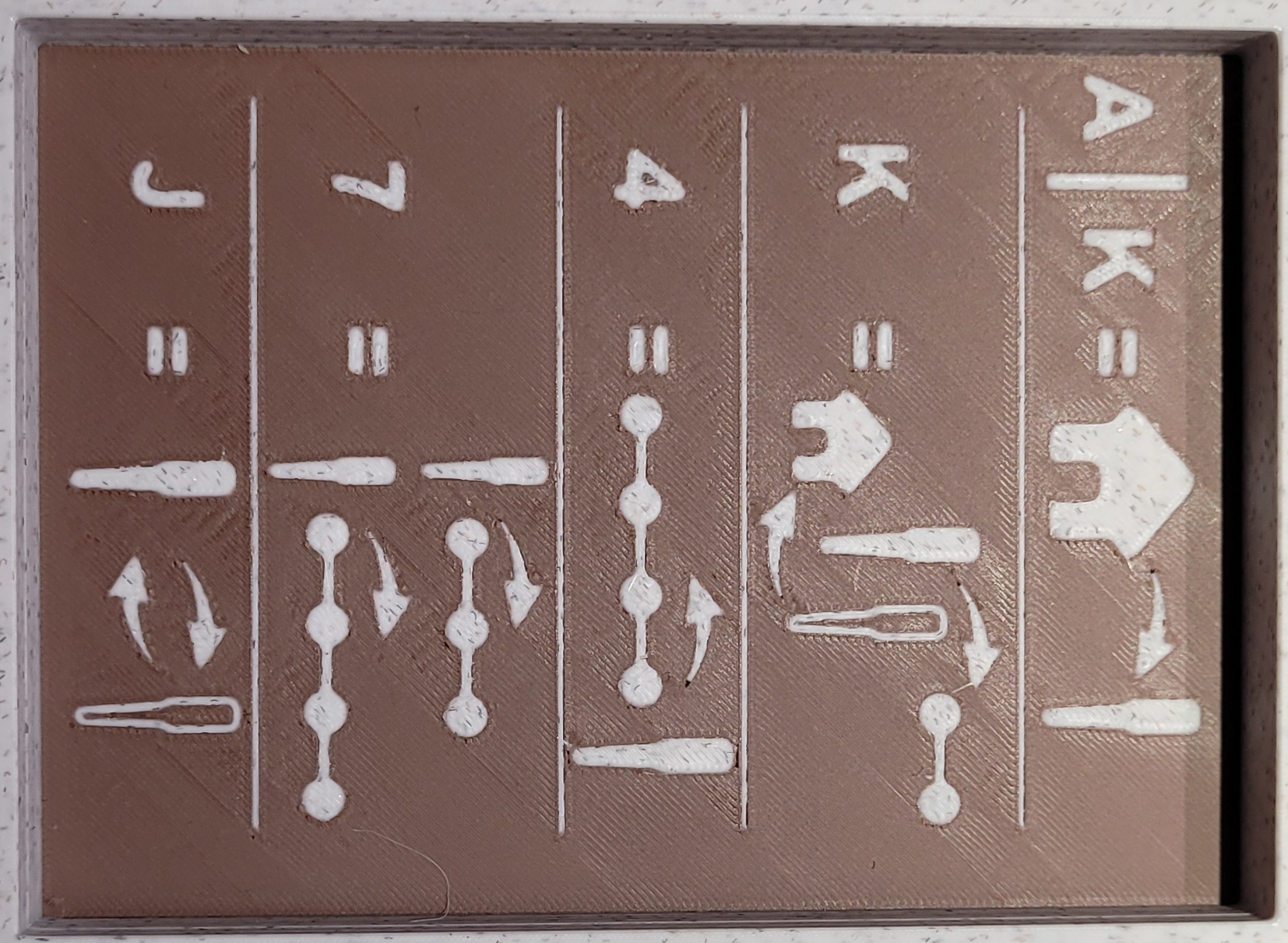
Ace or King Leave Start
Ace or King can get you out of your start.
Works from any location in the start row (Start 3 → 0, for example).
4 Backward
4 can go backwards. It’s the only way to move backwards.
7 Split Move
Split your movement across as many of your pieces as you want (move one 2 spaces and another 5). You must still move a total of 7 spaces.
Jack Swap
Jack can swap your piece with any other player piece.
King Pass & Send Home
King can also send any opposing player back to their start if you pass them with it.
Variants
2 Players
- Remove one board.
- Deal becomes two hands of 7 and two hands of 6.
3 Players
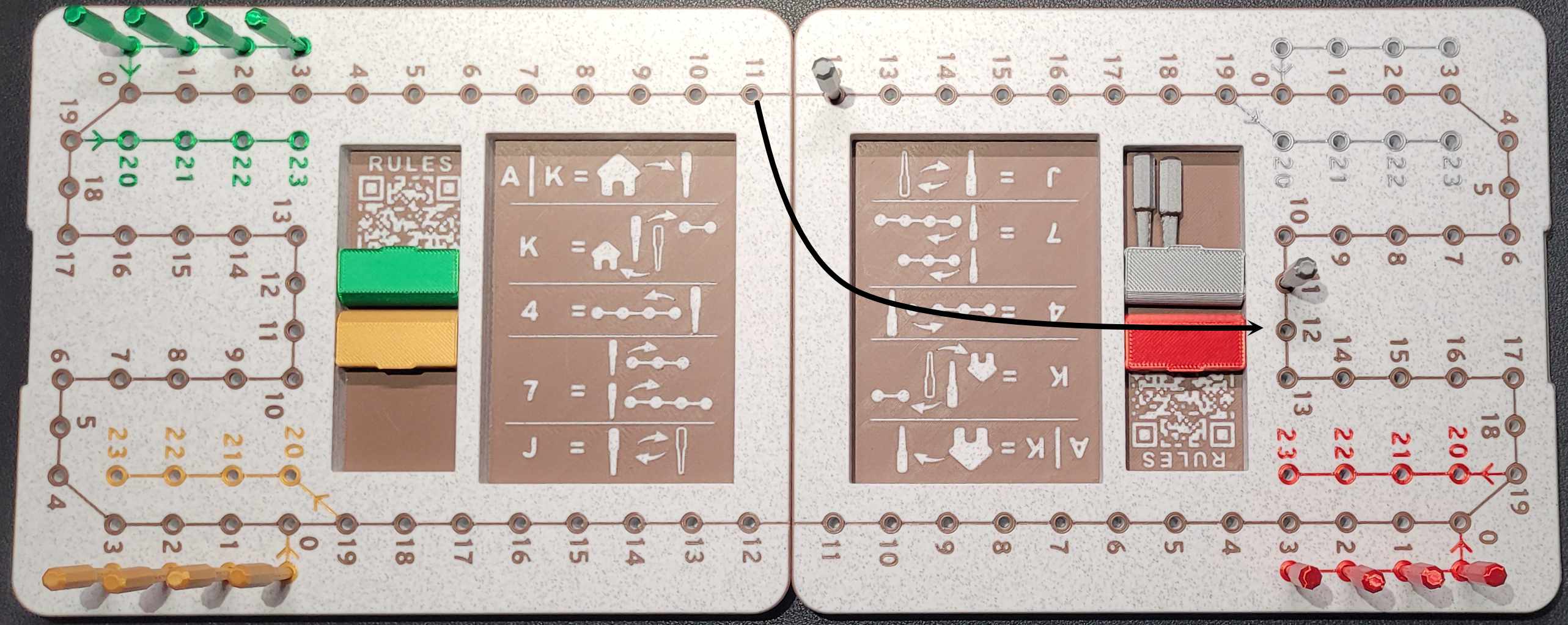
- Ignore one section of play. You can use player 4’s pegs to mark the area off.
- Place a peg on the 12 at the start of the board and 11 at the midway point.
- No more teams: 1v1v1.
- Deal becomes two hands of 6 and one hand of 5, with one card leftover at the end.
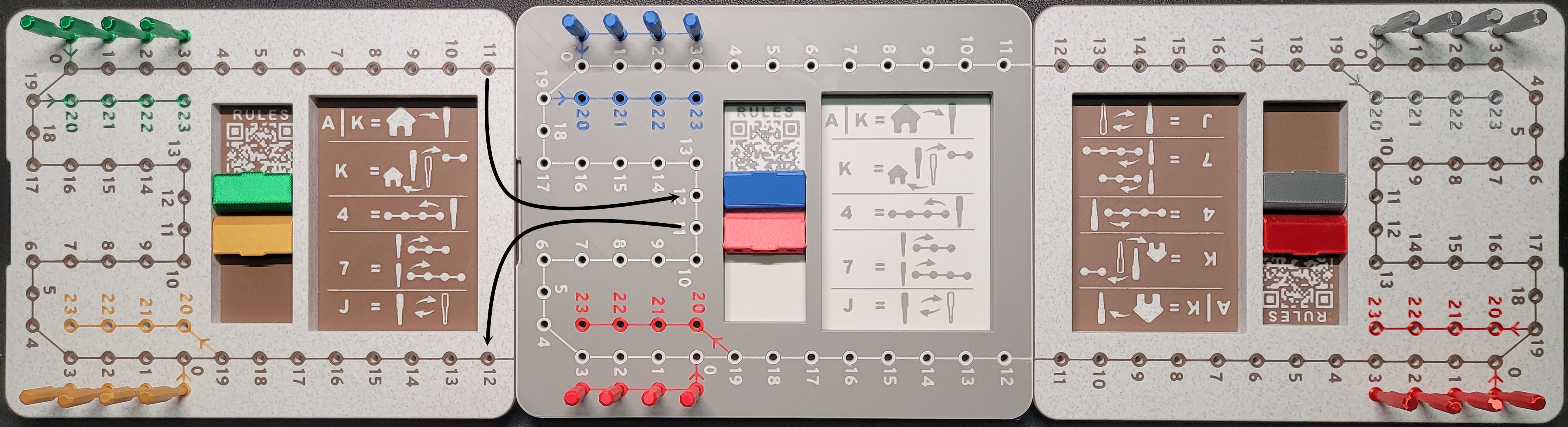
6 Players
- If you have a second game, place it in the middle. Movement gets a bit weird:
- The midpoint 11 on the middle board goes to the 12 on the next board.
- The 11 on the end board goes to the 12 at the midpoint of the middle board.
- Do 3 teams of 2.
- Use 2 decks. Deal two hands of 6 and one hand of 5 with two cards leftover at the end.
- It actually works okay once everyone understands the odd movement around the middle.
Suggestions
Any suggestions or problems: email printing@jsbg.ca and I’ll get back to you.
Shoutouts
Special thanks to Taylor for introducing me to the original game (Dashka), Rylie for the new name to go with the revised rules and Jonothan for the wood/resin board with what turned out to be a great layout.
Buy a Copy!
If you're interested in purchasing another or your own copy of the game check out the Boards Page to see the existing boards or aim to make one of your very own!
Change Log
- V1.1 - Updated email addresses and added link to boards page.
- V1 – Finalized rules and variants.